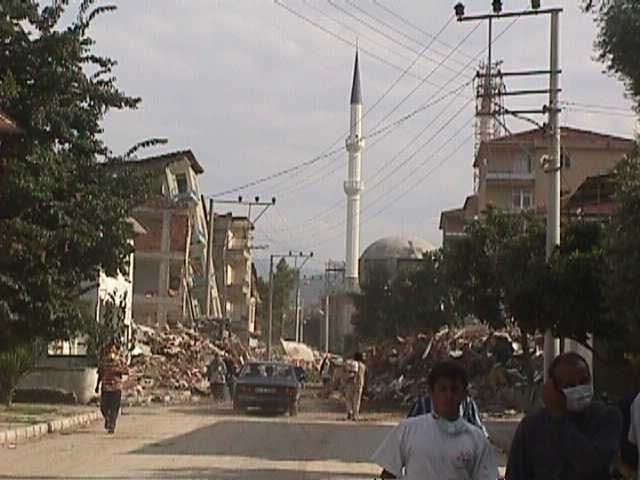
ARCHIVE / USGS · Izmit, Turkey · 20 Aug 1999 Context image; not the 2020 event in Report B.EVENT → IMPACT → RESPONSE
01 / WATCH THE BRIEFING
The story behind the terms
2 min 16 sec
Meet the key terms before you return to the reports. Listen for magnitude, focal depth and search and rescue.
Course introduction · Teacher-supplied English narration · English captions on by default On your phone, use full screen for diagrams. / 手机观看图解时可横屏或全屏播放。
Read the transcript / 查看英文稿与中文辅助
INTERACTIVE / INSIDE THE EARTH
From Earth's layers to an earthquake
Optional · 2–3 min
Explore the layers. Then follow a fault as it locks, slips and releases energy. 探索地球内部,再分步观察地震如何发生。拓展学习,可按需使用。
01
Explore the layers in 3D
Hover, tap or use the layer buttons. / 悬停、轻触或选择下方按钮。
EARTH / FOUR MAIN LAYERS
Fixed-view 3D illustration · On a phone, swipe the image sideways or use the layer buttons. 固定视角立体示意图;手机可左右滑动图片,或用下方按钮选择地层。各层厚度与间距不按比例。
SELECTED LAYER / 当前地层
Mantle
地幔
Mostly solid rock
A thick layer of hot, mostly solid rock beneath the crust. It can flow very slowly over geological time.
地壳下方厚厚的高温岩石层,主要呈固态,在地质时间尺度上可极缓慢流动。
USE THE TERM
The mantle lies between the crust and the core.
Connect the ideas: The crust and rigid uppermost mantle form the lithosphere. Tectonic plates are pieces of this rigid outer shell.地壳与最上部刚性的地幔共同组成岩石圈(lithosphere);构造板块是岩石圈的组成块体。
02
How does an earthquake begin?
A 3D reverse-fault example / 立体逆断层简化示例
On a phone, swipe the model sideways to inspect the cutaway. / 手机可左右滑动立体图查看剖面。
A fault is a fracture along which rocks have moved. / 断层是岩石沿其发生过相对位移的破裂面。
STEP 01 / 04
Plates move slowly
Tectonic plates move slowly. Opposing forces load the rocks in this reverse-fault example.
构造板块缓慢运动。在此逆断层示例中,相向作用力使岩石承受挤压。
One simplified reverse-fault mechanism, not every earthquake. The front face is a cutaway. Wave rings show energy spreading, not cracks or a realistic wave field.这是逆断层地震的简化示例,不涵盖所有地震类型;前侧为剖切面。波纹示意能量传播,不代表裂缝或真实波场。
Review the eight focus items first. Open any word for its meaning, pronunciation and a teaching example.
Examples are written for teaching; they are not live news updates.
03 / READ THE REPORTS
One topic. Two reporting priorities.
4 min
Report A follows earthquake parameters. Report B follows people and rescue. Both are historical textbook cases.
HISTORICAL CASE · JULY 2020 · TEXTBOOK PP. 3–4
Four earthquakes, four sets of data
According to the National Centre for Seismology, four earthquakes struck the Andaman and Nicobar Islands on a Friday in July 2020. The first, of magnitude 4.8, occurred at 10:31. Its epicenter was 250 km east of Port Blair. The earthquake occurred at a depth of 10 km.
The second earthquake occurred at 18:59, with a magnitude of 5.1 and a depth of 62.3 km. The third followed at 19:33. It had a magnitude of 5.6, an epicenter 264 km east of Port Blair, and a depth of 10 km. The fourth occurred at 20:12, northeast of Campbell Bay, at a depth of 185 km.
The report noted no immediate reports of loss of life or property damage after the first event.
18:59 → 19:33 = 34 minutes. Magnitude, depth and distance are different measurements.
同一天发生不等于同一时刻发生;不要把其他地区或历史背景事件计入这四次。
HISTORICAL CASE · JANUARY 2020 · TEXTBOOK PP. 8–10
Impact and rescue in eastern Turkey
An earthquake with a preliminary magnitude of 6.7 struck eastern Turkey near Sivrice in Elazig Province. The textbook report gives the time as 20:55 local time, or 17:55 UTC.
According to the report, at least 22 people were killed and over 1,000 were injured. Nearly 80 buildings collapsed. Search and rescue teams worked through the night to reach people trapped under rubble.
Over 2,000 personnel were dispatched. Beds, blankets and tents were provided for displaced people, and public buildings were opened for shelter. Residents were warned against returning to damaged buildings because further aftershocks remained possible. These figures describe the reporting stage in the textbook; they are not final totals or a current update.
Dates refer to publication or update dates shown by the source. Some outlets carry Xinhua reports; different outlets do not always mean independent sources.
Which numbers describe the earthquake itself, which describe its impact, and which describe the response? Record the publication date before comparing figures from different reports.